Navigating Relationship OCD: What It Is, What It Isn’t, and How Loved Ones Can Help

Healing Childhood Trauma:
Rewire Your Relationships & Reclaim Your Adult Self
Erik Turley, LMFT
08/04/2026
Growing up should feel safe. When it does not, the impact can last long into adulthood. If your childhood was shaped by fear, neglect, or instability, you might notice that the pain from your past keeps showing up in your present. It can affect your mental health, your physical well-being, and especially your closest relationships.
If you are a survivor of childhood trauma, please hear this: You are seen, your pain is real, and it was not your fault. However, healing also requires a hard truth. While your past explains your present struggles, it does not excuse destructive behavior today. Healing means accepting that your inner child was hurt, while stepping up as the adult who must take responsibility for your growth and accountability for how you treat others.
The Footprints of the Past: The ACEs Study
To understand how childhood adversity affects us, we must look at the science. In a landmark scientific study, researchers looked at how childhood trauma links to adult health problems (Felitti et al., 1998). This study created a tool called the Adverse Childhood Experiences (ACE) questionnaire, a 10-item scale that checks for childhood abuse, neglect, and household dysfunction (Zarse et al., 2019).
The results were eye-opening. The researchers discovered a “dose-response” relationship—meaning the higher a person’s ACE score, the greater their risk for mental illness, addiction, and physical diseases later in life (Zarse et al., 2019). This data proves that you cannot simply “get over” childhood adversity; it changes how your brain and body handle stress.
The Invisible Biology: Neurobiology and Epigenetics
Trauma does not just live in your memories; it alters your physical biology. Chronic childhood stress changes the physical structure of the brain. When a child is constantly afraid, the amygdala (the brain’s emotional smoke detector responsible for the fight-or-flight response) becomes enlarged and hyperactive (Pagani et al., 2021). At the same time, the prefrontal cortex (the area linked to logical thinking, reasoning, and emotional control) loses volume and shrinks (Pagani et al., 2021).
As shown in the brain diagram above, trauma creates a physical imbalance where the threat detector overpowers the logical brain. When an unhealed adult encounters a relational trigger, their amygdala flashes an immediate alarm, rendering them temporarily unable to access their logical prefrontal cortex. This is why minor relationship stressors feel like life-or-death crises.
Furthermore, childhood adversity impacts us through epigenetics—a field of study showing how your environment and life experiences can change the way your genes work without altering your actual DNA sequence (Lines & Taylor, 2022). Chronic stress in childhood can alter the chemical tags on your DNA, leaving survivors with a permanently sensitive nervous system that is highly prone to inflammation and anxiety (Lines & Taylor, 2022).
The Trauma of Parental Divorce and the Fractured Family Unit
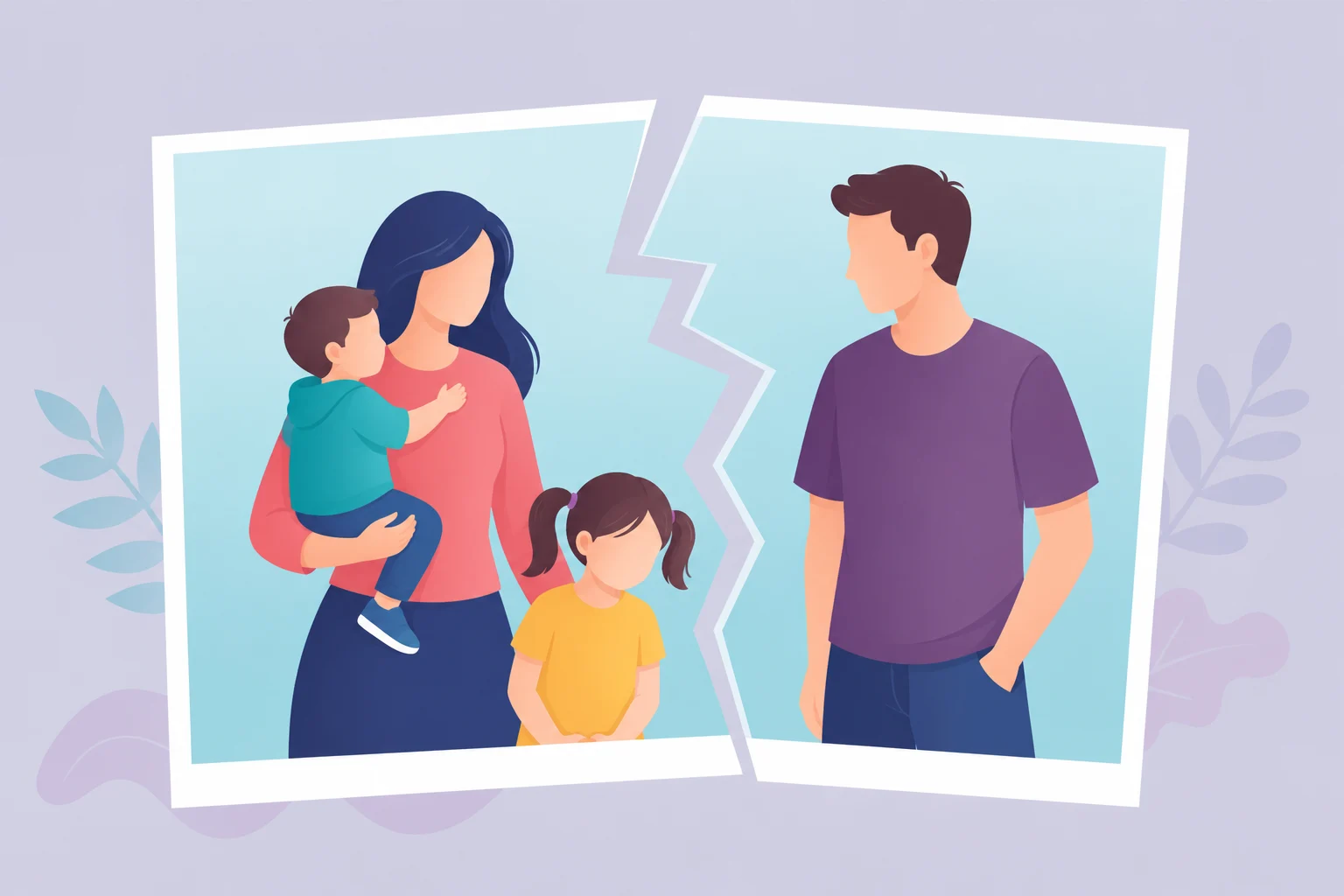
Shaking the Core: Self-Worth and Self-Concept
The environment provided by both parents dictates the architecture of a child’s self-concept (the collection of beliefs and ideas a person holds about themselves) and their self-worth (the deep internal conviction that one is valuable and deserving of love) (Rogers, 1959).

As depicted in the image above, a healthy self-concept functions like a clear mirror, allowing an individual to see their inherent value. When caregivers provide a consistent emotional safety net, a child internalizes that positive reflection. However, when both parents are wrapped up in chronic marital warfare, or when one parent completely withdraws, the child’s internal mirror cracks.
Studies confirm that children from high-conflict or divorced families display significantly lower self-esteem and more fragile self-concepts in adulthood than peers from intact families (Amato, 2001; Mustonen et al., 2011). Without a secure base, the child develops a core identity rooted in deficiency. In adult relationships, this manifests as an agonizing, constant question: “How could my partner possibly love me when my own parents couldn’t stay to love me?“
The Blueprint of Love: Gender Dynamics and Parental Relationships
While the overall relationship with both parents sets a child’s general safety baseline, the relationship with the parent of the opposite sex plays a highly specific role in shaping future romantic expectations (Bowlby, 1973).
According to psychodynamic and attachment research, the opposite-sex parent serves as a child’s very first template for romantic love and gender-based interaction (Flouri, 2005).
- For a young girl, her relationship with her father outlines how she expects men to treat her body, her voice, and her boundaries. A distant, critical, or abandoning father often primes her to accept emotionally unavailable or volatile partners in adulthood, normalizing a pattern of chasing love (Flouri, 2005).
- For a young boy, his relationship with his mother dictates how he perceives female emotional expression and vulnerability. A mother who is intrusive, smothering, or emotionally rejecting can cause him to view female closeness as a trap, leading to intense avoidance or relational hostility later in life (Mikulincer & Shaver, 2007).
However, it is a mistake to view this dynamic in a vacuum. The relationship between the two parents—how they communicate, argue, and respect one another—serves as a child’s primary laboratory for relationship behavior (Bandura, 1977). Children learn how to love by watching how their parents love. When that dynamic is defined by screaming, passive-aggression, or complete abandonment, the child’s brain writes those behaviors down as the standard operating procedure for intimacy.
Attachment Theory: How Early Bonds Shape Adult Love
John Bowlby explained that human infants are born with a biological need to form close emotional bonds with a primary caregiver (Bowlby, 1969). When a caregiver is warm and responsive, a child develops a secure attachment, creating an “internal working model”—an inner blueprint that says people are safe and trustworthy (Ainsworth, 1979).
However, when parents are abusive, distant, or unpredictable, children develop insecure attachment styles (Ainsworth, 1979; Scharfe & Cole, 2006). In adulthood, these insecure patterns translate into deep-seated relational struggles (Shaver & Mikulincer, 2002).
As detailed in the attachment style spectrum chart above, psychologists divide these adult relational struggles into two primary axes:
- Attachment Anxiety: A constant fear that people will abandon or reject you, leading to hyperactivating strategies—over-activating your attachment system through constant reassurance-seeking, clinginess, or frantic texting (Shaver & Mikulincer, 2008).
- Attachment Avoidance: A deep distrust of other people’s intentions, causing an individual to use deactivating strategies—subconscious behaviors meant to suppress emotional needs and enforce strict psychological distance, such as shutting down or pulling away (Shaver & Mikulincer, 2008).

The Ripple Effect on Intimate Relationships
When you carry childhood trauma into adult romance, the unhealed wounds often collide with your partner’s boundaries. Research shows that childhood emotional maltreatment directly undermines the quality of adult romantic relationships (Sun et al., 2021). Survivors of childhood trauma frequently report lower trust, more frequent arguments, and higher relationship dissatisfaction (Sun et al., 2021).
Furthermore, this trauma does not just stay inside the survivor; it actively spills over onto their partners. A recent large-scale analysis found that a person’s childhood maltreatment is directly linked to lower relationship satisfaction, higher stress reactivity, and increased conflict for their partner (Vaillancourt-Morel et al., 2023). A longitudinal study of newlyweds even discovered that childhood maltreatment predicted lower relationship satisfaction that steadily worsened over time (DiLillo et al., 2009).
When these attachment wounds are severe, adult survival behaviors can closely mimic the rigid, destructive patterns found in personality disorders—such as Borderline Personality Disorder (BPD) or Avoidant Personality Disorder (AvPD) (McLean & Gallop, 2003; Sperry, 2016). In a trauma-informed framework, these “personality traits” are understood as unhealed, defensive coping mechanisms that have frozen into place (Herman, 1992).
The Bait-and-Switch of Vulnerability: Three Relational Patterns
True closeness requires dropping your emotional armor and trusting that your partner won’t use your softness to hurt you. For someone with severe childhood trauma, dropping this guard feels incredibly dangerous. The moment real intimacy begins to form, a hidden, protective mechanism slams the door shut, cutting vulnerability short.
Pattern Name
Harm OCD Intrusive Thoughts
Harm OCD Intrusive Thoughts
Genuine Violent Ideation / Psychopathy
Emotional Response
Intense horror, panic, guilt, and profound distress.
Intense horror, panic, guilt, and profound distress.
Anger, satisfaction, indifference, or a desire for control.
Relation to Identity
Ego-dystonic (repulsive and completely contrary to who they are).
Ego-dystonic (repulsive and completely contrary to who they are).
Ego-syntonic (feels justified, aligned with their current goals or anger).
Behavioral Outcome
Extreme avoidance of anything “dangerous” (knives, driving, crowds, being alone).
Extreme avoidance of anything “dangerous” (knives, driving, crowds, being alone).
Preparation, gathering weapons, or actively planning an attack.
Core Goal
To guarantee 100% safety and ensure no harm ever occurs.
To guarantee 100% safety and ensure no harm ever occurs.
To inflict harm or seek retribution.
The Trap of Trauma Bonding
When two unhealed trauma survivors find each other, these dysfunctional dynamics expand exponentially. This often results in a trauma bond—an unhealthy emotional attachment that develops due to a cyclical pattern of intense abuse or chaos followed by affectionate reassurance and reward (Dutton & Painter, 1993).
An individual with an anxious attachment style (who clings) will frequently attract someone with an avoidant attachment style (who runs). They create a volatile, addictive loop: One partner panics and clings, the other feels suffocated and withdraws, which triggers more panic and clinging. Couples often mistake this high-stakes chemical roller coaster for true “passion,” when it is actually just shared, unhealed childhood trauma playing out in an adult arena (Dutton & Painter, 1993; Scharfe & Cole, 2006).
Healing the Inner Child: Reparenting and the "Good Inside" Approach
If your parents could not give you the stable foundation you needed, you must learn to give it to yourself. This process is called reparenting—the practice of treating yourself with the validation, boundaries, and care that you lacked as a child.
Dr. Becky Kennedy, a well-known psychologist and author of Good Inside, provides a beautiful framework that can guide adult recovery (Kennedy, 2022). Her core philosophy is that beneath our messy behaviors, we are all inherently “good inside.” When an adult acts out, snaps at a partner, or panics over a text, it is not because they are a bad person; it is because a hurt, overwhelmed part of them has taken control.
Reparenting means noticing when you are spiraling and stepping in as the strong, compassionate adult your inner child never had. Instead of shaming yourself for having a big emotional reaction, you acknowledge the pain, but you firmly guide your behavior. You can say to yourself: “I am safe right now. It makes sense that I feel scared, but I am not going to yell at my partner.“
The Ultimate Rule: Impact vs. Intent
To fully step into adulthood, a trauma survivor must master the distinction between intent (what you meant to do) and impact (the actual psychological or emotional damage you caused your partner).
Trauma survivors often shield themselves with their intentions: “I didn’t mean to hurt you, I just panicked because of my childhood!” While your intent may have been driven by a scared inner child trying to protect itself, the impact on your partner was still destructive.
Being “good inside” means you have the baseline goodness required to clean up your mess (Kennedy, 2022). True adulthood means saying: “My inner child threw that tantrum, but as the adult, I am responsible for apologizing, repairing the damage, and changing my behavior.“

Taking the Final Step: Responsibility vs. Accountability
When it comes to healing relational trauma, people often use the words “responsibility” and “accountability” as if they mean the exact same thing. They do not. To truly heal, an adult must step up to both.
- Responsibility is internal. It is the realization that your healing is your own job, even if you did not cause the original wounds. It means acknowledging, “My parents hurt me, but it is my responsibility to go to therapy, practice reparenting, and learn how to manage my nervous system.”
- Accountability is external and relational. It is about answering to others for the consequences of your actions. It means standing before your partner, looking at the emotional damage your behavior caused, and owning it without making excuses.
True accountability sounds like this: “I am the one who chose to scream and smash that cup. I am accountable for making you feel unsafe in your own home. Your anger and fear are completely valid, and I am not going to blame my childhood to get out of trouble.“
When you only take responsibility, you might quietly work on yourself in private while continuing to act in childish, defensive, or chaotic ways during an argument. You might tell yourself, “Well, I’m trying my best in therapy, so my partner just needs to be patient with me.” That is a dangerous trap.
Accountability means accepting that your partner has the right to protect their own peace. They are not required to tolerate your unhealed survival weapons just because you have a tragic history. Healing means using your adult self to protect your inner child, so that your inner child stops attacking the people who love you.
Cutting-Edge Modalities for Deep Healing
Because childhood trauma is deeply wired into the nervous system, talk therapy alone is sometimes not enough to reach those survival responses. Fortunately, specialized therapies can help rewire the brain.
EMDR and EMDR 2.0
Eye Movement Desensitization and Reprocessing (EMDR) is an eight-step therapy designed to help the brain process stuck traumatic memories using bilateral stimulation—side-to-side eye movements, alternating sounds, or physical taps (Gainer, 2021). Countless studies show that standard EMDR drastically reduces symptoms of trauma, anxiety, and depression (Chen et al., 2014).
An updated variation called EMDR 2.0 takes this a step further. It works by heavily taxing working memory—the short-term system our brain uses to hold active information (Matthijssen et al., 2021). By forcing a client to recall a painful memory while simultaneously performing complex tasks (like counting backward or tapping a rhythm), the brain cannot hold onto the full emotional weight of the memory. Research confirms that EMDR 2.0 requires fewer treatment sets to take the painful “sting” out of traumatic memories, making it highly efficient for severe trauma (Matthijssen et al., 2021; Matthijssen & Menses, 2024).
Internal Family Systems (IFS)
Another powerful approach is Internal Family Systems (IFS), a therapy that views the human mind as a collection of different “parts,” led by an innate, compassionate “Self” (Mok, 2023; Schwartz, 2001). Traumatic experiences force these parts into extreme roles:
- Exiles: The vulnerable, child-like parts carrying the core pain, shame, and fear of the trauma (de Boer et al., 2025).
- Managers: Protective parts that proactively control our environment to keep the exiles hidden, often through perfectionism or emotional distance (de Boer et al., 2025).
- Firefighters: Reactive parts that rush in to extinguish emotional pain through impulsive behaviors like substance use, binging, or explosive anger (de Boer et al., 2025).
Clinical trials show that IFS is highly effective at reducing trauma symptoms and relieving substance cravings by helping individuals safely access, calm, and unburden their hurt inner parts (Ally, 2025).
The Path Forward: Seen and Accountable
Your childhood might have been messy, unpredictable, or cruel. You deserved better. But the beauty of being an adult is that you are no longer trapped in that environment. You have the power to seek out resources like EMDR, explore IFS, and practice reparenting.
You are fully seen in your pain, and you are entirely capable of change. True healing begins when you stop blaming your past for your present bad habits, put down your childhood weapons, and choose to build a safe, loving life for yourself and the people around you.
Resources
Ainsworth, M. D. S. (1979). Infant–mother attachment. American Psychologist, 34(10), 932–937. https://doi.org/10.1037/0003-066x.34.10.932
Ally, D. (2025). A pilot study of an online group-based Internal Family Systems intervention for comorbid posttraumatic stress disorder and substance use. Frontiers in Psychiatry, 16, 1544435. https://doi.org/10.3389/fpsyt.2025.1544435
Amato, P. R. (2001). Children of divorce in the 1990s: An update of the Amato and Keith (1991) meta-analysis. Journal of Family Psychology, 15(3), 355–370. https://doi.org/10.1037/0893-3200.15.3.355
Amato, P. R., & Anthony, C. J. (2014). Estimating the effects of parental divorce and death on children: New models for old questions. Journal of Marriage and Family, 76(2), 370–386. https://doi.org/10.1111/jomf.12096
Bandura, A. (1977). Social learning theory. Prentice-Hall.
Bowlby, J. (1969). Attachment and loss: Vol. 1. Attachment. Basic Books.
Bowlby, J. (1973). Attachment and loss: Vol. 2. Separation: Anxiety and anger. Basic Books.
Chen, Y. R., Hung, K. W., Tsai, J. C., Chu, H., Chung, M. H., Chen, S. R., Liao, Y. M., Ou, K. L., Chang, Y. C., & Chou, K. R. (2014). Efficacy of Eye-Movement Desensitization and Reprocessing for Patients with Posttraumatic-Stress Disorder: A Meta-Analysis of Randomized Controlled Trials. PLoS ONE, 9(8), e103676. https://doi.org/10.1371/journal.pone.0103676
de Boer, K., Mackelprang, J. L., & Nedeljkovic, M. (2025). The relationship between symptoms of complex posttraumatic disorder and core concepts in Internal Family Systems therapy. Clinical Psychologist, 29, 1–10. https://doi.org/10.1080/13284207.2025.2467123
DiLillo, D., Lewis, T., & Martinez, I. (2009). Childhood maltreatment and marital functioning: A longitudinal study of newlywed couples. Journal of Family Psychology, 23(5), 740–751. https://doi.org/10.1037/a0016644
Dutton, D. G., & Painter, S. (1993). Emotional attachments in abusive relationships: A test of traumatic bonding theory. Violence and Victims, 8(2), 105–120. https://doi.org/10.1891/0886-6708.8.2.105
Felitti, V. J., Anda, R. F., Nordenberg, D., Williamson, D. F., Spitz, A. M., Edwards, V., Koss, M. P., & Marks, J. S. (1998). Relationship of childhood abuse and household dysfunction to many of the leading causes of death in adults: The Adverse Childhood Experiences (ACE) Study. American Journal of Preventive Medicine, 14(4), 245–258. https://doi.org/10.1016/s0749-3797(98)00017-8
Flouri, E. (2005). Fathering and child outcomes. Wiley. https://doi.org/10.1002/9780470713181
Gainer, D. (2021). A flash of hope: Eye Movement Desensitization and Reprocessing (EMDR) therapy. Mental Health Review, 12, 45–52.
Herman, J. L. (1992). Complex PTSD: A syndrome in survivors of prolonged and repeated trauma. Journal of Traumatic Stress, 5(3), 377–391. https://doi.org/10.1002/jts.2490050305
Kennedy, B. (2022). Good inside: A guide to becoming the parent you want to be. Harper Wave.
Lines, S., & Taylor, M. (2022). Epigenetic modifications in childhood trauma: A systematic review of cortisol regulation pathway alterations. Journal of Neuroendocrinology, 34(3), e13091. https://doi.org/10.1111/jne.13091
Matthijssen, S. J. M. A., Brouwers, T., van Roozendaal, C., Vuister, T., & de Jongh, A. (2021). The effect of EMDR versus EMDR 2.0 on emotionality and vividness of aversive memories in a non-clinical sample. European Journal of Psychotraumatology, 12(1), 1956793. https://doi.org/10.1080/20008198.2021.1956793
Matthijssen, S. J. M. A., & Menses, S. D. F. (2024). Case report: Intensive online trauma treatment combining prolonged exposure and EMDR 2.0 in a patient with severe and chronic PTSD. Frontiers in Psychiatry, 15, 1370358. https://doi.org/10.3389/fpsyt.2024.1370358
McLean, L. M., & Gallop, R. (2003). Implications of childhood sexual abuse for adult partner relationships and personality disorder presentations. Journal of Personality Disorders, 17(5), 433–452. https://doi.org/10.1521/pedi.17.5.433.22143
Mikulincer, M., & Shaver, P. R. (2007). Attachment in adulthood: Structure, dynamics, and change. Guilford Press.
Mok, C. H. B. (2023). Internal Family Systems Therapy (IFS): A Compassionate Approach to Therapy. Counselling & Psychotherapy Review Singapore, 1(1), 22–35.
Mustonen, U., Huurre, T., Kiviruusu, O., Haukkala, A., & Aro, H. (2011). Long-term effects of parental divorce on adult self-esteem: The mediating role of psychosocial resources. Journal of Divorce & Remarriage, 52(6), 401–419. https://doi.org/10.1080/10502548.2011.586612
Pagani, S., Amann, B. L., Landin-Romero, R., & Hofman, A. (2021). Neurobiological changes following EMDR and EMDR 2.0 in patients with complex trauma: A structural MRI analysis. Frontiers in Psychology, 12, 683412. https://doi.org/10.3389/fpsyg.2021.683412
Piaget, J. (1952). The origins of intelligence in children. International Universities Press. https://doi.org/10.1037/11144-000
Rogers, C. R. (1959). A theory of therapy, personality, and interpersonal relationships, as developed in the client-centered framework. In S. Koch (Ed.), Psychology: A study of a science (Vol. 3, pp. 184–256). McGraw-Hill.
Scharfe, E., & Cole, V. (2006). Stabilizing the roller coaster: Adult attachment styles, emotional regulation, and the stability of romantic relationships over time. Personal Relationships, 13(1), 87–101. https://doi.org/10.1111/j.1475-6811.2006.00106.x
Schwartz, R. C. (2001). Internal Family Systems Therapy. Guilford Press.
Shaver, P. R., & Mikulincer, M. (2002). Attachment-related psychodynamics. Attachment & Human Development, 4(2), 133–161. https://doi.org/10.1080/14616730210154171
Shaver, P. R., & Mikulincer, M. (2008). Adult Attachment and Cognitive and Affective Reactions to Positive and Negative Events. Social and Personality Psychology Compass, 2(5), 1844–1865. https://doi.org/10.1111/j.1751-9004.2008.00146.x
Sperry, L. (2016). Handbook of Diagnosis and Treatment of DSM-5 Personality Disorders (3rd ed.). Routledge. https://doi.org/10.4324/9781315689111
Sun, L., Canevello, A., Lewis, K. A., Li, J., & Crocker, J. (2021). Childhood Emotional Maltreatment and Romantic Relationships: The Role of Compassionate Goals. Frontiers in Psychology, 12, 723126. https://doi.org/10.3389/fpsyg.2021.723126
Vaillancourt-Morel, M. P., Bussières, È. L., Nolin, M. C., & Daspe, M. È. (2023). Partner Effects of Childhood Maltreatment: A Systematic Review and Meta-Analysis. Trauma, Violence, & Abuse, 25(4), 1150–1167. https://doi.org/10.1177/15248380231173427
Zarse, E. M., Neff, M. R., Yoder, R., Hulvershorn, L., Chambers, J. E., & Chambers, R. A. (2019). The adverse childhood experiences questionnaire: Two decades of research on childhood trauma as a primary cause of adult mental illness, addiction, and medical diseases. Cogent Medicine, 6(1), 1581447. https://doi.org/10.1080/2331205x.2019.1581447