
Healing Childhood Trauma: Rewire Your Relationships & Reclaim Your Adult Self

The Stress Triangle:
How Hidden Trauma and Intrusive Thoughts Feed Anxiety
Erik Turley, LMFT
08/11/2026
When people talk about feeling “stressed,” they are often referring to a wide variety of emotional and physical feelings. However, in mental health, not all stress works the same way. Stress can come from painful past events, current unwanted thoughts, or a constant state of being on high alert.
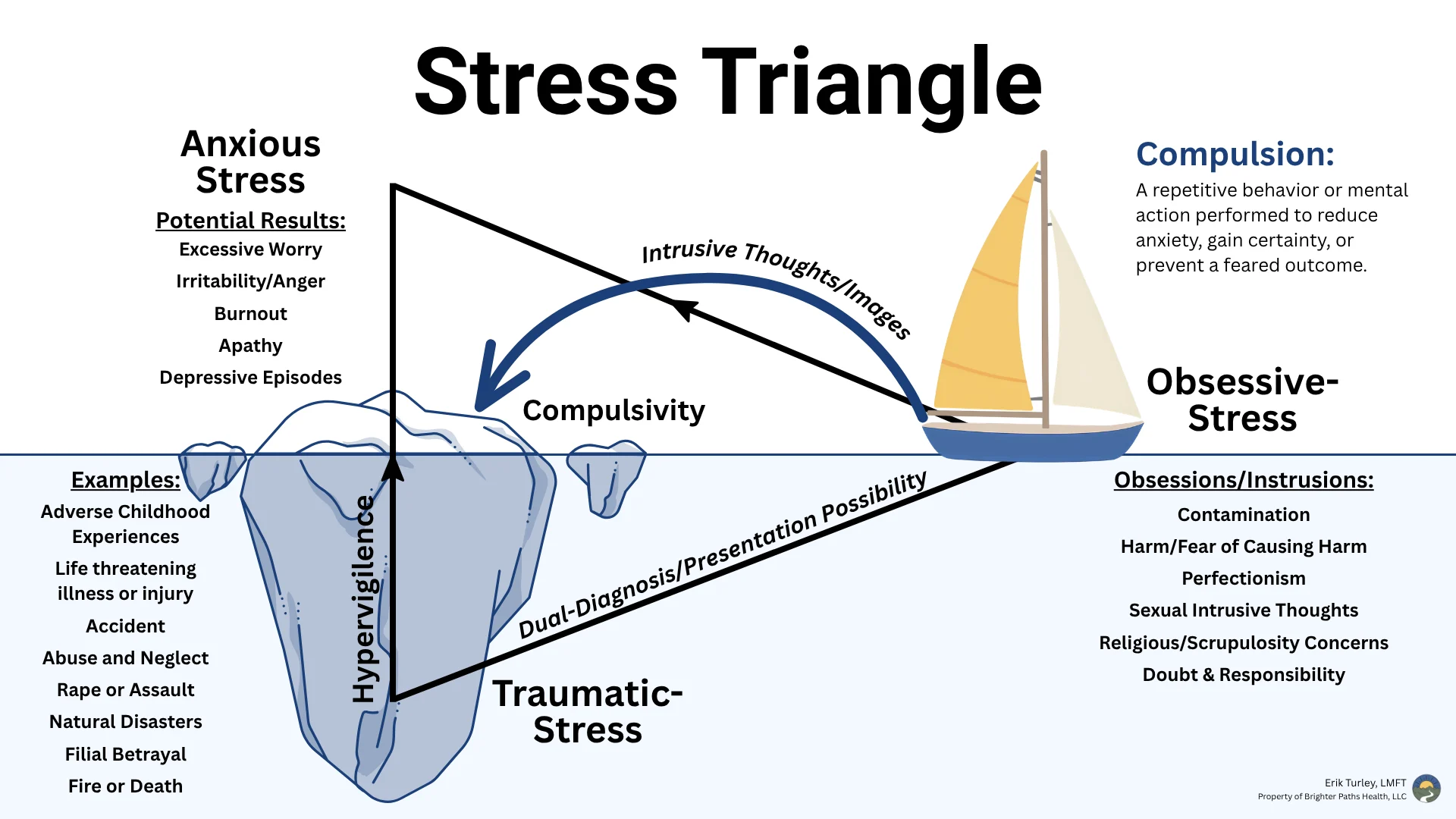
To help visualize how these different feelings work together, I created a framework called The Stress Triangle. By combining the idea of an iceberg (where most of the problem is hidden under the surface) with the connections between Traumatic-Stress, Obsessive-Stress, and Anxious Stress, this visual tool shows how hidden past experiences and repetitive mental habits create everyday anxiety.
1. Beneath The Surface: Traumatic-Stress And The Iceberg Effect
In psychology, the Iceberg Effect is a visual metaphor—a mental picture where a small object represents a bigger idea. It shows that the behaviors we can see on the outside are often just a small piece of what is hidden deep inside a person. At the bottom base of the Stress Triangle rests Traumatic-Stress, which is anchored deep under the waterline. Traumatic stress is a strong emotional and physical reaction that happens when a person goes through or sees an event that threatens their safety or life (American Psychological Association [APA], 2020). As shown in the diagram, these hidden underlying experiences often include:
- Adverse Childhood Experiences (ACEs): Difficult or traumatic events that happen during childhood, such as abuse, neglect, or severe family instability (Felitti et al., 1998).
- Filial Betrayal: A specific type of trauma where a parent or primary caregiver—the person meant to protect a child—causes them severe emotional or physical harm.
- Severe Life Events: Physical abuse, neglect, assault, natural disasters, serious accidents, or life-threatening illnesses (Dube et al., 2003; Shalev et al., 2017).
The Role of Hypervigilance
When trauma goes unhealed, the body’s nervous system stays on defense mode to keep you safe. This leads to hypervigilance—an automatic, body-based state where your brain keeps your senses on high alert, constantly scanning your surroundings for possible danger (Kimble et al., 2014). Hypervigilance is not just a thought; it is an automatic survival reflex in the body.
Real-Life Examples of Hypervigilance:
- Scanning Your Surroundings for Threat: A survivor of an assault enters a crowded restaurant and feels unsafe unless they sit with their back against a wall where they can watch every door.
“I can’t enjoy my meal if my back is to the door. It’s not that I’m thinking about a specific threat; my whole body just feels like it’s bracing for an impact until I can see every exit.“
- Extreme Sensitivity to Sound: A person who grew up in an unstable home wakes up startled at the smallest noise in the house.
“Every noise makes my heart race before I even know what I’m listening for. My brain is constantly asking, ‘Are we safe right now?’“
- Tracking Facial Expressions: Someone who experienced emotional abuse as a child closely watches their partner’s small expressions or slight changes in voice tone.
“When your mood shifts even a fraction, my mind immediately jumps into threat-assessment mode to figure out if I’m about to be attacked or rejected.“
In the Stress Triangle diagram, hypervigilance is shown by the arrow pointing straight up from the hidden iceberg to the top of the triangle. Studies show that staying in a state of constant hypervigilance floods the body with stress hormones, directly driving high levels of Anxious Stress even when no actual danger is around (Piacente et al., 2021).
2. Navigating The Wind: Obsessive-Stress And Intrusive Thoughts
On the right side of the diagram sits a sailboat labeled Obsessive-Stress. While traumatic stress comes from past events buried deep below the waterline, obsessive stress happens in the present moment—focusing heavily on fear, risk, and wanting complete control. You can picture obsessive-stress like a sailboat that suddenly appears out of nowhere, catching a gust of wind and throwing unwanted, upsetting thoughts directly onto the top tip of your iceberg.
These thoughts are called obsessions or intrusions—recurrent, unwanted, and distressing thoughts, images, or impulses that pop into a person’s head against their will (National Institute of Mental Health [NIMH], 2023). When these intrusive thoughts land on a nervous system that is already on guard from past trauma, they cause a fast spike in anxiety. Common themes include:
- Contamination Concerns: An extreme fear of germs, dirt, or illness (Stein et al., 2019).
- Harm OCD: An intense, unwanted fear of accidentally or intentionally hurting oneself or someone else (Veale & Roberts, 2014).
- Perfectionism and Scrupulosity: Extreme worry about making mistakes or an overwhelming fear of breaking moral or religious rules (Inozu et al., 2012).
- Sexual Intrusive Thoughts: Taboo or disturbing sexual images that go completely against a person’s values (Purdon & Clark, 1999).
3. The Reinforcement Loop: Compulsivity vs. Hypervigilance

When They Happen Together In The Same Moment
Because trauma and obsessive stress often happen together—a clinical overlap known as comorbidity—a person can experience both hypervigilance and compulsivity at the exact same time (Huppert et al., 2020):
Scenario 1: Getting Ready for Bed
- Hypervigilance (Body Alert): Listening intensely to every small creak outside the house while feeling muscle tension. (“My body is braced for an intruder.”)
- Compulsivity (Action Ritual): Getting out of bed to lock, unlock, and re-lock the door four times because of an intrusive thought about a break-in. (“I have to do this sequence so the scary thought in my head goes away.”)
Scenario 2: Driving at Night
- Hypervigilance (Body Alert): Gripping the steering wheel tightly and constantly checking all three mirrors for reckless drivers. (“My brain is treating the road like a battlefield.”)
- Compulsivity (Action Ritual): Turning the car around to re-drive over a small bump in the road three times after an intrusive thought asks “What if you hit someone?” (“I turn around to prove to myself that nothing bad happened.”)
Scenario 3: Answering Messages
- Hypervigilance (Body Alert): Watching a person’s small shifts in tone or posture during a meeting to see if they are mad. (“My body is scanning for signs that I am in trouble.”)
- Compulsivity (Action Ritual): Sending multiple text messages asking “Are we okay?” to get instant reassurance. (“I must ask for reassurance to quiet my intrusive thoughts.”)
When an intrusive thought drops onto the tip of the iceberg, a person performs these compulsions to calm their mind. While compulsions give short-term relief, they trap the person in a negative reinforcement cycle (Abramowitz et al., 2017). This term means that because the ritual temporarily removes the bad feeling, the brain falsely learns that the compulsion was necessary for survival. As a result, the intrusive thoughts return even stronger the next time, pushing anxiety higher up the triangle. Research shows that trauma can alter how the brain processes thoughts, making a person more likely to develop obsessive-compulsive behaviors as a way to cope with unpredictable trauma triggers (Cludius et al., 2017; Gershuny et al., 2002).
4. The Top Peak: Anxious Stress and Its Consequences
At the top peak of the Stress Triangle sits Anxious Stress. This represents the total physical and mental toll caused by the combination of hidden trauma, hypervigilance, intrusive thoughts, and compulsive cycles. Anxious Stress is a widespread state of worry and physical tension (NIMH, 2022). When it stays high for a long time, it causes several difficult health outcomes:
- Excessive Worry & Irritability: Finding it very hard to control daily worries, leading to short tempers and emotional outbursts.
- Burnout: A state of total physical, emotional, and mental exhaustion caused by long-term stress (Maslach & Leiter, 2016).
- Apathy: Feeling emotionally numb or losing interest in activities you used to enjoy.
- Depressive Episodes: Extended periods of deep sadness, feeling hopeless, and having low energy brought on by constant distress (Segerstrom & Miller, 2010).
Conclusion
The Stress Triangle demonstrates that anxiety rarely happens in isolation. By looking at how submerged trauma (hypervigilance) and active thought cycles (obsessions and compulsions) feed into each other, we get a much clearer picture of what a person is going through.
While hypervigilance keeps the body’s safety alarm running in the background to spot outer danger, compulsivity drives repetitive behaviors to neutralize inner intrusive thoughts. Recognizing how these mechanisms work together is essential for real healing. Recovery often requires targeted therapies that address both sides of the triangle:
- Eye Movement Desensitization and Reprocessing (EMDR): A trauma-focused therapy that helps the brain reprocess buried traumatic memories so the nervous system can drop its state of hypervigilance.
- Exposure and Response Prevention (ERP): A specialized therapy for obsessive thoughts that helps people gradually face intrusive thoughts without giving in to compulsive behaviors.
By using EMDR to heal the trauma below the waterline and ERP to break the compulsive cycles above it, people can calm the nervous system and achieve true, lasting relief.
Figure 1: The Stress Triangle Framework
Resources
Abramowitz, J. S., Deacon, B. J., & Whiteside, S. P. (2017). Exposure therapy for anxiety: Principles and practice (2nd ed.). Guilford Press.
American Psychiatric Association. (2013). Diagnostic and statistical manual of mental disorders (5th ed.). https://doi.org/10.1176/appi.books.9780890425596
American Psychological Association. (2020). APA dictionary of psychology: Trauma. https://dictionary.apa.org/trauma
Cludius, B., Krüger-Gottschalk, A., & Mennin, D. S. (2017). Repetitive thought in anxiety disorders: Moving beyond ruminating about the negative. Psychiatric Clinics of North America, 40(4), 727–738. https://doi.org/10.1016/j.psc.2017.08.010
Dube, S. R., Felitti, V. J., Dong, M., Chapman, D. P., Giles, W. H., & Anda, R. F. (2003). Childhood abuse, neglect, and household dysfunction and the risk of illicit drug use: The Adverse Childhood Experiences study. Pediatrics, 111(3), 564–572. https://doi.org/10.1542/peds.111.3.564
Felitti, V. J., Anda, R. F., Nordenberg, D., Williamson, D. F., Spitz, A. M., Edwards, V., & Marks, J. S. (1998). Relationship of childhood abuse and household dysfunction to many of the leading causes of death in adults: The Adverse Childhood Experiences (ACE) Study. American Journal of Preventive Medicine, 14(4), 245–258. https://doi.org/10.1016/S0749-3797(98)00017-8
Gershuny, B. S., Baer, L., Radomsky, A. S., Wilson, K. A., & Jenike, M. A. (2002). Connections among trauma, posttraumatic stress disorder, and obsessive-compulsive disorder. Behaviour Research and Therapy, 40(10), 1135–1157. https://doi.org/10.1016/S0005-7967(01)00086-3
Huppert, J. D., Simpson, H. B., & Barlow, D. H. (2020). Assessment and treatment of comorbid generalized anxiety disorder and obsessive-compulsive disorder. In S. G. Hofmann & D. J. Dozois (Eds.), The Wiley handbook of cognitive behavioral therapy (Vol. 1, pp. 267–289). Wiley Blackwell. https://doi.org/10.1002/9781118528570.ch14
Inozu, M., Clark, D. A., & Karanci, A. N. (2012). Scrupulosity in Islam: A comparison of highly religious Turkish and Canadian samples. Behavior Therapy, 43(1), 190–202. https://doi.org/10.1016/j.beth.2011.06.002
Kimble, M. O., Boxwala, M., Bean, W., Maletsky, K., Halper, J., Spollen, K., & Fleming, K. (2014). The behavior of hypervigilance: Evidence for a forward feedback loop. Journal of Anxiety Disorders, 28(8), 812–815. https://doi.org/10.1016/j.janxdis.2014.09.004
Maslach, C., & Leiter, M. P. (2016). Understanding the burnout experience: Recent research and its implications for psychiatry. World Psychiatry, 15(2), 103–111. https://doi.org/10.1002/wps.20311
National Institute of Mental Health. (2022). Generalized anxiety disorder: When worry gets out of control. U.S. Department of Health and Human Services. https://www.nimh.nih.gov/health/publications/generalized-anxiety-disorder-gad
National Institute of Mental Health. (2023). Obsessive-compulsive disorder. U.S. Department of Health and Human Services. https://www.nimh.nih.gov/health/topics/obsessive-compulsive-disorder-ocd
Piacente, J. C., Koster, E. H., & De Raedt, R. (2021). Vigilance, disengagement, or avoidance: Which attention mechanisms underlie anxiety and trauma? A meta-analysis. Psychological Bulletin, 147(11), 1145–1182. https://doi.org/10.1037/bul0000346
Purdon, C., & Clark, D. A. (1999). Metacognition and the misattribution of obsession-like intrusive thoughts. Psychotherapy and Psychosomatics, 68(5), 241–251. https://doi.org/10.1159/000012338
Segerstrom, S. C., & Miller, G. E. (2010). Psychological stress and the human immune system: A meta-analytic study of 30 years of inquiry. Psychological Bulletin, 130(4), 601–630. https://doi.org/10.1037/0033-2909.130.4.601
Shalev, A., Liberzon, I., & Marmar, C. (2017). Post-traumatic stress disorder. The New England Journal of Medicine, 376(25), 2459–2469. https://doi.org/10.1056/NEJMra1612499
Stein, D. J., Costa, D. L., Lochner, C., Miguel, E. C., Reddy, Y. C., Shavitt, R. G., van den Heuvel, O. A., & Simpson, H. B. (2019). Obsessive-compulsive disorder. Nature Reviews Disease Primers, 5(1), 52. https://doi.org/10.1038/s41572-019-0102-3
Veale, D., & Roberts, A. (2014). Obsessive-compulsive disorder. BMJ, 348, g2183. https://doi.org/10.1136/bmj.g2183