
The Stress Triangle: How Hidden Trauma and Intrusive Thoughts Feed Anxiety

Overcoming Harm OCD:
How To Break The Cycle And Find Peace
Erik Turley, LMFT
07/21/2026
Few experiences are as terrifying as a mind that suddenly turns against its own values. Imagine preparing dinner with a loved one when, out of nowhere, an intense, vivid image flashes across your mind: What if I grabbed this knife and stabbed them?
For most people, a fleeting, bizarre thought like this is dismissed as a weird brain glitch. In fact, pioneering research reveals that upwards of 90% of the healthy population experiences these exact same intrusive thoughts—which are random, unwanted, and often weird thoughts that pop into your head out of nowhere (Purdon & Clark, 1993). The difference isn’t the thought itself; it’s how your brain reacts to it.
For someone living with Harm Obsessive-Compulsive Disorder (Harm OCD)—a type of OCD where people get scary, unwanted thoughts about hurting themselves or others—this passing thought triggers a localized psychological earthquake. The brain sounds a massive alarm, launching them into an agonizing cycle of panic, self-doubt, and desperate attempts to prove they are not a monster.
Because of the frightening nature of these thoughts, Harm OCD is one of the most misunderstood and deeply stigmatized (socially shamed) subtypes of OCD. Those who suffer from it often do so in absolute silence, terrified that seeking help will get them locked up or labeled as dangerous.
What Harm OCD Is And Isn’t
To understand Harm OCD, we have to look at how psychiatrists and psychologists define the way thoughts connect to our identity. It is crucial to understand that Harm OCD is an anxiety disorder, not a behavioral threat. Decades of clinical literature show that there is virtually no risk of a person with OCD acting on their harm-related obsessions (Veale et al., 2009). There is a massive, scientifically validated difference between having an intrusive thought about harm and having a violent impulse (Rachman, 1997).
- A violent impulse is ego-syntonic. This means the thoughts align with a person’s actual desires, anger, or dark urges (ego-syntonic means the thoughts feel like something the person actually wants to do). A violent individual may feel a drive to hurt someone and might experience pleasure, anger, or a sense of justice in planning it.
- A Harm OCD obsession is strictly ego-dystonic. This means the thoughts completely oppose the person’s true desires, morals, and identity (ego-dystonic means the thoughts feel gross, scary, and totally unlike who the person actually is). The thoughts are horrifying to the sufferer precisely because they value safety, love, and life. The anxiety is not generated by a desire to hurt someone, but by the utter dread of doing so.
This agonizing panic is further driven by a well-documented cognitive distortion—a sneaky trick or pattern of thinking where your brain convinces you of something that isn’t actually true. In this case, the trick is called Thought-Action Fusion (TAF) (Shafran et al., 1996). Sufferers fall into the trap of believing that merely thinking about a violent act is morally just as bad as actually doing it, or that thinking about harm makes it physically more likely to happen.
Comparing Harm OCD to Genuine Violence
Feature
Harm OCD Intrusive Thoughts
Genuine Violent Ideation / Psychopathy
Emotional Response
Intense horror, panic, guilt, and profound distress.
Anger, satisfaction, indifference, or a desire for control.
Relation to Identity
Ego-dystonic (repulsive and completely contrary to who they are).
Ego-syntonic (feels justified, aligned with their current goals or anger).
Behavioral Outcome
Extreme avoidance of anything “dangerous” (knives, driving, crowds, being alone).
Preparation, gathering weapons, or actively planning an attack.
Core Goal
To guarantee 100% safety and ensure no harm ever occurs.
To inflict harm or seek retribution.
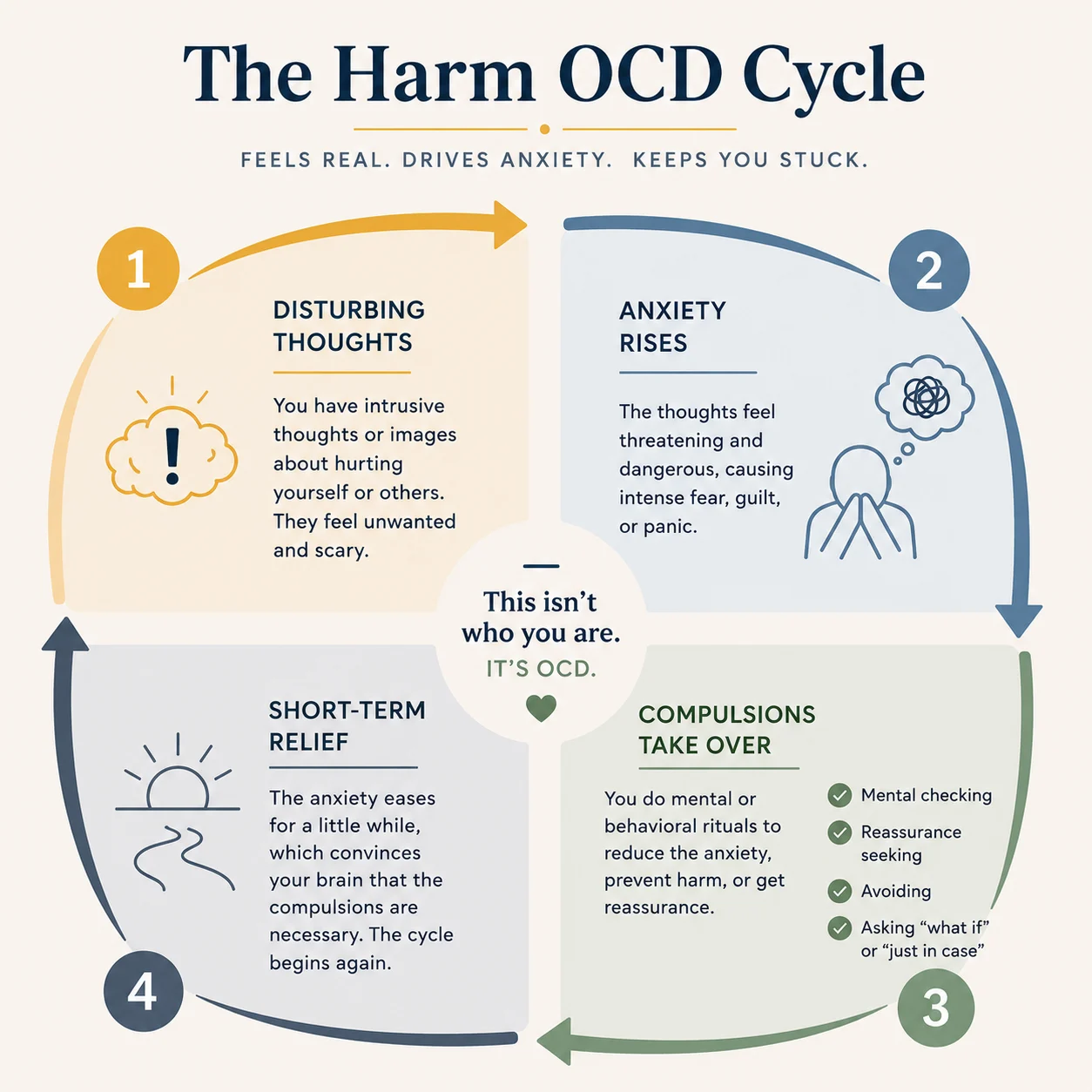
The Harm OCD Cycle: Obsessions and Compulsions
Common Obsessions
Obsessions in Harm OCD can focus on harming others or harming oneself. They often sound like:
- “What if I lose control and push this stranger in front of the subway train?”
- “What if I turn the steering wheel into oncoming traffic right now?”
- “How do I know for sure I won’t suddenly snap and kill my spouse in their sleep?”
- “What if I secretly want to hurt my baby, and I’m just hiding it from myself?”
A Note on Postpartum Harm Thoughts:
This is incredibly common in new parents. Research shows that nearly half of all new parents experience terrifying, unwanted thoughts of intentionally harming their infant (Abramowitz et al., 2006). These thoughts are not a sign of postpartum psychosis (a severe mental emergency where a person loses touch with reality), nor do they mean the parent is aggressive. Instead, they are simply the brain’s safety-monitoring system going into overdrive due to the immense responsibility of caring for a newborn.
Common Compulsions
Because the anxiety of these thoughts is so overwhelming, the sufferer feels driven to perform compulsions to find temporary relief or ensure safety. In Harm OCD, these compulsions are often quiet, mental, and hidden:
- Avoidance (Physical & Situational): Hiding all the kitchen knives, refusing to hold scissors, avoiding being alone with children or pets, or refusing to drive.
- Mental Review: Endlessly replaying past events in their head to “prove” they didn’t accidentally hurt someone. They might think, “When I drove over that bump, did I hit a pedestrian? Let me replay the drive second-by-second.”
- Checking Behaviors: Checking the news to see if any hit-and-runs were reported along their driving route, or repeatedly checking a loved one’s pulse to make sure they are okay.
- Reassurance Seeking: Asking partners, parents, or friends questions like, “Do you think I’m a bad person?” or “You know I would never hurt anyone, right?“
The Ripple Effect: How Harm OCD Impacts Relationships
Harm OCD does not exist in a vacuum; it deeply affects couples and families. When a person is constantly fighting an internal war against horrific images, their capacity to connect with the people they love is severely compromised.
1. Emotional Distancing and “Unexplained” Avoidance
Because those with Harm OCD are terrified of their thoughts, they often pull away from their loved ones physically and emotionally. A husband might sleep in a separate bed to “protect” his wife from his potential sleepwalking violence; a mother might avoid holding her child.
To a family member who does not know about this internal battle, this behavior looks like sudden coldness, rejection, or a loss of love. Research highlights that this physical and emotional avoidance often leads to significant relationship conflict, distance, and a steep drop in relationship satisfaction (Baucom et al., 2003).
2. High Expressed Emotion and Caregiver Burnout
Living with someone who has severe OCD can place an extraordinary emotional burden on family members. As a partner’s frustration grows over time, they may interpret the sufferer’s avoidance or checking rituals as deliberate or manipulative.
This misunderstanding can lead to high levels of Expressed Emotion (EE)—which is a psychological term for a home environment filled with high levels of criticism, hostility, and over-involvement (Steketee, 1997). High family criticism not only hurts the relationship but also makes treatment less effective for the sufferer.
3. The Reassurance Trap
When family members try to help by offering reassurance, they enter a cycle of family accommodation—which is when loved ones change their own behaviors, answer OCD questions, or help with rituals to keep the sufferer calm (Calvocoressi et al., 1995).
Over time, the partner is no longer just a romantic companion; they are drafted into acting as a “safety buffer.” This shifts the relationship dynamic from an equal partnership to a caregiver-dependent loop, leaving the partner feeling exhausted, resentful, and burnt out (Toohey et al., 2024).
How to Break the Cycle: Actionable Strategies
Overcoming Harm OCD requires retuning the brain’s alarm system. This is done through structured, evidence-based (scientifically proven) treatments.
1. Refuse to Answer the OCD (For Loved Ones)
If you are a spouse or family member, you must gently stop giving reassurance. Instead of answering reassurance questions, call out the pattern with love.
You can say: “I love you, but I know this is an OCD question. If I answer it, I am feeding the OCD, and I want to help you get better. So, I am not going to answer.”
2. Embrace the Power of “Maybe, Maybe Not”
OCD thrives on a need for absolute certainty. Because 100% certainty about the future is mathematically impossible, OCD exploits this gap.
The ultimate tool to combat this is leaning into the uncertainty. When the terrifying thought spikes (“What if I lose control and hurt someone?”), instead of arguing with the thought or trying to prove you wouldn’t, respond with:
“Maybe I will lose control, and maybe I won’t. I can’t know for sure.”
This phrase strips the OCD of its power. By refusing to debate the thought, you teach your brain’s fear center (the amygdala) that you do not need to fight or run from it. Over time, the brain stops firing the alarm, and the thoughts naturally lose their terrifying weight and begin to fade away.
3. Gradual Exposure
Under the guidance of a licensed OCD specialist, sufferers practice gradually facing their fears. This might mean sitting in a room with a butter knife on the table, driving a car with a passenger, or holding a baby—all while actively choosing not to seek reassurance or perform mental checks.

Professional Help is Available: You Are Not Alone
If you are fighting this battle, please know this: you are dealing with a highly treatable neurobiological (brain-based) glitch, not a character flaw. There is a path out of the darkness, and you do not have to walk it alone.
Gold-Standard Treatments
- Exposure and Response Prevention (ERP): This specialized form of Cognitive Behavioral Therapy (CBT) is widely accepted as the primary psychological treatment for OCD. ERP systematically guides you to confront your obsessive thoughts (exposure) without engaging in safety behaviors or mental checks (response prevention). Research shows that partner-assisted ERP—where your loved one is trained to support your therapy homework rather than accommodate your compulsions—significantly improves both symptom reduction and relationship satisfaction (Abramowitz et al., 2013).
- Acceptance and Commitment Therapy (ACT): Often used alongside ERP, ACT teaches cognitive defusion—which means learning to see your thoughts as just words or pictures in your head, rather than scary facts you have to react to (Twohig et al., 2010). Instead of trying to eliminate or disprove your thoughts, ACT helps you accept them as harmless brain noise.
- Pharmacotherapy (Medication): For many, a combination of therapy and medication offers the most robust relief. Selective Serotonin Reuptake Inhibitors (SSRIs) are clinically proven to help turn down the volume of the brain’s alarm system, making the psychological work of ERP much more manageable.
Where to Find Support
You don’t have to suffer in silence or fear judgment from professionals who specialize in this condition.
- The International OCD Foundation (IOCDF): A global resource (iocdf.org) that provides educational materials, support groups, and a directory of licensed, verified OCD specialists who specifically understand ego-dystonic harm thoughts.
- Association for Behavioral and Cognitive Therapies (ABCT): Offers a comprehensive “Find a Therapist” tool specializing in cognitive-behavioral approaches like ERP.
Conclusion
Living with Harm OCD can feel like being trapped in a constant, exhausting battle with your own mind. But it is crucial to remember the single most important truth of this condition: your intrusive thoughts are not a reflection of your character, your desires, or your future actions. They are simply the product of a misfiring anxiety response, amplified by the very fact that you care deeply about being a safe, good person. By learning to sit with the uncertainty, refusing to feed the cycle of compulsions, and seeking specialized support like ERP, you can break free. You are not your thoughts—and you have the power to reclaim your peace of mind from fear.
More Articles On OCD
Resources
Abramowitz, J. S., Khandker, M., Nelson, C. A., Deacon, B. J., & Rygwall, R. (2006). The characterization of unwanted intrusive thoughts in pregnancy and postpartum. Journal of Cognitive Psychotherapy, 20(2), 147–159. https://doi.org/10.1891/jcop.20.2.147
Abramowitz, J. S., Schulz, H. E., Foa, E. B., & Franklin, M. E. (2013). Partner-assisted exposure and response prevention for obsessive-compulsive disorder: A randomized controlled trial. Journal of Behavior Therapy and Experimental Psychiatry, 44(4), 441–448. https://doi.org/10.1016/j.jbtep.2013.05.006
Baucom, D. H., Stanton, S., & Epstein, N. (2003). Evaluating interpersonal functioning in couples. In G. P. Kealey (Ed.), Evaluating and treating couples (pp. 15–32). Brunner-Routledge.
Calvocoressi, L., Lewis, B., Harris, M., Trufan, S. J., Goodman, W. K., McDougle, C. J., & Price, L. H. (1995). Family accommodation in obsessive-compulsive disorder. The American Journal of Psychiatry, 152(3), 441–443. https://doi.org/10.1176/ajp.152.3.441
Purdon, C., & Clark, D. A. (1993). Obsessive intrusive thoughts in nonclinical subjects. Part I. Content and relation to depressive, anxious and obsessive symptoms. Behaviour Research and Therapy, 31(8), 713–720. https://doi.org/10.1016/0005-7967(93)90001-B
Rachman, S. (1997). A cognitive theory of obsessions. Behaviour Research and Therapy, 35(9), 793–802. https://doi.org/10.1016/S0005-7967(97)00040-5
Shafran, R., Thordarson, D. S., & Rachman, S. (1996). Thought-action fusion in obsessive compulsive disorder. Journal of Anxiety Disorders, 10(5), 379–391. https://doi.org/10.1016/0887-6185(96)00018-7
Steketee, G. (1997). Expressed emotion and cognitive behavioral therapy for obsessive-compulsive disorder. Journal of Anxiety Disorders, 11(4), 407–424. https://doi.org/10.1016/S0887-6185(97)00019-3
Toohey, B. G., Quinlan, E., Reece, J., & Paparo, J. (2024). A preliminary study of factors associated with accommodation of obsessive-compulsive symptoms by romantic partners. British Journal of Clinical Psychology, 63(4), 499–515. https://doi.org/10.1111/bjc.12499
Twohig, M. P., Hayes, S. C., Plumb, J. C., Pruitt, L. D., Collins, A. B., Hazlett-Stevens, H., & Mututo, W. R. (2010). A randomized clinical trial of acceptance and commitment therapy versus progressive relaxation training for obsessive-compulsive disorder. Journal of Consulting and Clinical Psychology, 78(5), 705–716. https://doi.org/10.1037/a0020508
Veale, D., Freeston, M., Krebs, G., Heyman, I., & Salkovskis, P. (2009). Risk assessment and management in obsessive-compulsive disorder. Advances in Psychiatric Treatment, 15(5), 332–343. https://doi.org/10.1192/apt.bp.107.004564