
Resources
Practical info to help you get the most from your care.
Finding Our Office
North-Eastern Entrance
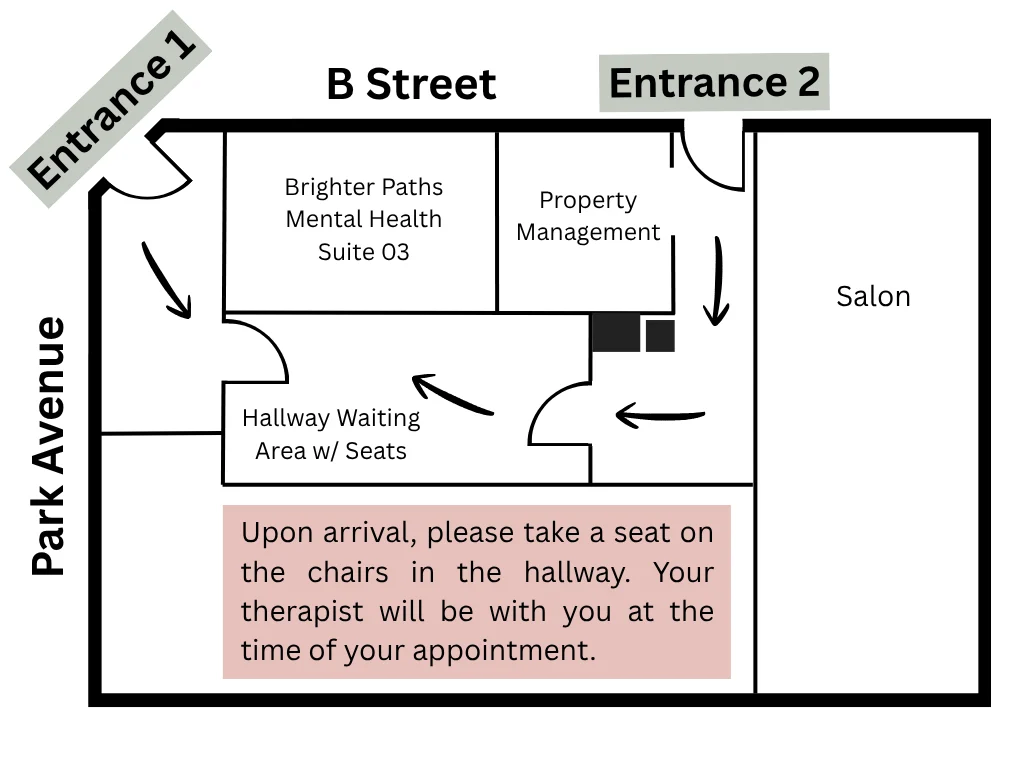
Please refer to the image above should you find difficulty reaching our office location.
Seek The Horizon
One Step At A Time
We’ll be right by your side. You don’t have to walk the path alone.
Payment, Fees, & Cancellations
Important
At Brighter Paths Mental Health, we currently operate as a private-pay practice, though we are in the process of expanding to accept insurance in the coming months. This model allows us to protect your privacy and focus fully on your treatment goals without third-party interference, ensuring your care is dictated by your progress rather than external timelines. This approach allows us to provide the highest quality of care, designing a treatment plan that is a perfect fit for you, free from the constraints often imposed by insurance companies.
Session Rates
Please note that a standard therapy session (individual, couple, family) is 53-60 minutes.
- Standard Rate: Rates may differ depending on self-pay or insurance. Please contact for more information.
- ESA Letter Services: $200
- EMDR Intensives: Rates may vary based on the necessary session length—refer to our EMDR Intensives services page for more information.
Payment Methods
We accept all major credit and debit cards, including HSA and FSA cards linked to a credit card network. Payment is due at the time of service unless arranged in advance. Please contact us beforehand if you need to discuss payment concerns, as we are not able to carry balances or delay charges after sessions. We want to ensure that your experience is as seamless as possible, so please don’t hesitate to reach out with any questions regarding payment options. We are here to help.
Insurance & Superbills
We are excited to offer multiple payment options to make accessing care as convenient as possible. We currently accept the following insurance plans:
For Out-of-Network Insurance Plans
If we are not in network with your insurance provider, we are happy to provide a superbill—a detailed receipt that you may submit to your insurance company for possible out-of-network reimbursement.
Please note:
- Reimbursement is not guaranteed and depends on your individual insurance plan and benefits.
- We encourage you to contact your insurance company directly to ask:
- “Do you offer reimbursement benefits for out-of-network outpatient mental health services?”
- “What is the reimbursement rate?”
- “Is a diagnosis required for reimbursement?”
Our Commitment to Accessibility
We strive to make quality mental health care as accessible as possible. As opportunities arise to expand our in-network participation, we will continue to evaluate them thoughtfully while maintaining our commitment to personalized, high-quality care. In the meantime, we are pleased to offer superbills for clients seeking potential out-of-network reimbursement through their insurance benefits.






Cancellation Policy
We value your time and ask that you value ours as well. Please provide at least 48 hours’ notice for any cancellations or rescheduled appointments.
Appointments canceled with less than 48 hours’ notice—or missed entirely—will be subject to the full session fee, as this time has been reserved exclusively for you.
If you’re experiencing an emergency or unavoidable circumstance, please reach out directly.
Start Your Journey
One Click Away
Support is here when you’re ready. Begin toward meaningful change.
Other Resources & Information
Crisis & Emergency Support
Brighter Paths Mental Health is not a crisis center and does not provide emergency services. If you or a loved one is experiencing a mental health emergency or crisis, please use the resources below:
Emergency Services: Call 9-1-1
Suicide & Crisis Help: Call 9-8-8
Client Portal
If you are an existing client, you can use our secure portal to:
View and manage appointments
Complete intake paperwork
Send secure messages to your therapist
- Completed online questionnaires and assessments
Click below to be redirected to our online scheduling portal.
Mental Health Book Reviews
Browse our recommended reads to discover mental health insights and guidance that can help you decide if you’re ready to start your journey toward brighter paths.
Frequently Asked Questions
Do you accept insurance?
Yes! We currently accept the following insurance plans:
Blue Cross of Idaho
Select Health
Mountain Health Co-Op
PacificSource
St. Luke’s Health Partners / BrightPath
First Choice HealthIf we are in network with your insurance plan, we will bill your insurance directly in accordance with your plan benefits.
If we are out of network with your insurance provider, we do not bill insurance directly. However, we are happy to provide a superbill that you may submit to your insurance company for potential out-of-network reimbursement, depending on your plan’s coverage.
For clients who choose to pay privately or who have out-of-network insurance, this approach allows for greater flexibility and reduces many of the administrative and clinical restrictions that can accompany insurance-based care. If you’re unsure whether your plan is accepted, please don’t hesitate to reach out—we’re happy to help verify your coverage.
How do I get reimbursed by my insurance?
We can bill select plans only (St. Luke’s Health Partners / Bright Path through Select Health and Mountain Health CO-OP).
For all other insurance providers, we can provide you with a superbill after your session. You can submit this superbill to your insurance provider for potential out-of-network reimbursement. We encourage you to contact your insurance company beforehand to verify your out-of-network benefits. Should you require this, please send an email to info@mybrighterpaths.com to make your request.
Do you offer virtual or telehealth sessions?
Yes, we currently only provide counseling via secure telecommunication means (Telehealth/Video Call).
What ages do you work with?
We currently serve young adults, adults, elders, couples, and families. Please refer to your specific therapist’s profile for age specialties.
What is your cancellation policy?
We require a minimum of 48 hours’ notice for any cancellations or rescheduling of appointments. If you cancel with less than 48 hours’ notice, you will be responsible for the full session fee.
What forms of payment do you accept?
We accept all major credit and debit cards, including HSA (Health Savings Account) and FSA (Flexible Spending Account) cards.
How long is each session?
Most therapy sessions are 53-60 minutes. Some intensives or extended sessions are available upon request.
What types of therapy do you offer?
We offer a range of services, including individual, couples, and family therapy. We also specialize in trauma, offering EMDR Intensives, and we provide letters for Emotional Support Animals (ESAs).
What should I do in a mental health crisis?
If you are experiencing a mental health crisis, please call or text 988 or go to your nearest emergency room.
What is the difference between counseling and therapy?
The terms “counseling” and “therapy” are often used interchangeably. Generally, counseling tends to be short-term and focused on a specific issue or challenge, while therapy (or psychotherapy) can be a longer-term process that explores deeper, underlying patterns and past experiences. At Brighter Paths Counseling & Wellness, we offer a range of services that can be tailored to your specific needs, whether you’re looking for short-term support or more in-depth therapeutic work.
How do I know if therapy is right for me?
Deciding to start therapy is a personal choice. People seek therapy for many reasons, including managing stress, coping with a major life transition, addressing symptoms of a mental health condition like anxiety or depression, or simply wanting a safe space for personal growth. If you are struggling with a difficult issue or feel like you could benefit from professional support, therapy can be a valuable tool for gaining insight and developing new coping skills.
What should I expect during my first therapy session?
Your first session is an opportunity for us to get to know each other and determine if we are a good fit. We’ll review confidentiality and practice policies, and you’ll be able to share what brought you to therapy and what you hope to achieve. This is a collaborative process, and you don’t have to have all the answers. The goal is to create a safe, non-judgmental space for you to explore your thoughts and feelings.
What is confidentiality, and when can it be broken?
Confidentiality is a cornerstone of the therapeutic relationship. Everything you share in our sessions is kept private. There are a few legal and ethical exceptions to this rule, including if we believe you are an immediate danger to yourself or others, if a child or vulnerable adult is being abused or neglected, or if we receive a court order. We will review all of the details of our confidentiality policy during your first session.
What is the difference between a therapist or counselor, a psychologist, and a psychiatrist?
This is a common question. A therapist (or counselor) is a licensed professional who uses talk therapy to help clients with their mental and emotional health. A psychologist holds a doctoral degree and can also provide therapy, but they often specialize in psychological testing and research. A psychiatrist is a medical doctor who can diagnose mental health conditions, provide therapy, and, most importantly, prescribe and manage medication. We are professionals who specialize in therapy and wellness, under a general umbrella (Marriage & Family Therapists, [Clinical] Professional Counselors, or Clinical Social Workers).
How long does it take for therapy to work?
The length of time therapy takes is unique for each person. Some clients find relief from a specific issue in just a few sessions, while others may benefit from a long-term therapeutic relationship to address deeper patterns. The duration of therapy depends on your individual goals, the issues you are working through, and your commitment to the process. We will work together to create a treatment plan that fits your needs.
What is EMDR therapy, and how does it work?
EMDR (Eye Movement Desensitization and Reprocessing) is a specialized therapy approach designed to help people heal from trauma and other distressing life experiences. It works by using bilateral stimulation (such as eye movements) to help the brain process and “re-file” traumatic memories, reducing their emotional charge. We offer EMDR Intensives, which are longer, more focused sessions to accelerate the healing process.
Read our articles on EMDR:
Can therapy help with anxiety and depression?
Yes, therapy is highly effective in treating both anxiety and depression. We use evidence-based approaches to help you understand the root causes of your symptoms, develop healthy coping mechanisms, and change negative thought patterns. The goal is to help you regain control and improve your overall well-being.
Do you offer therapy for specific issues like grief, stress, or relationship problems?
We provide therapy for a wide range of concerns, including anxiety, depression, grief and loss, life adjustments and stress management, and relationship challenges. Our goal is to offer a supportive space where you can explore these issues and learn practical strategies to improve your life.
Learn about all of our services provided:
Brighter Paths Await
Schedule Today
When you’re ready, support is available. Take the first step toward relief.
Quick Reads Below

Attachment Theory Explained: Styles, Development & Relationship Patterns
Erik Turley, LMFT
10/02/2024
Attachment Theory explains how early bonds with caregivers shape emotional development, relationships, and mental health across the lifespan. By understanding...

Overcoming Harm OCD: How To Break The Cycle And Find Peace
Erik Turley, LMFT
07/21/2026
Living with Harm OCD can make you feel trapped by your own mind. Discover the truth behind these distressing intrusive...